
Workplace Breathalysers and Road Safety: Why Testing at Work Matters After Hours Too
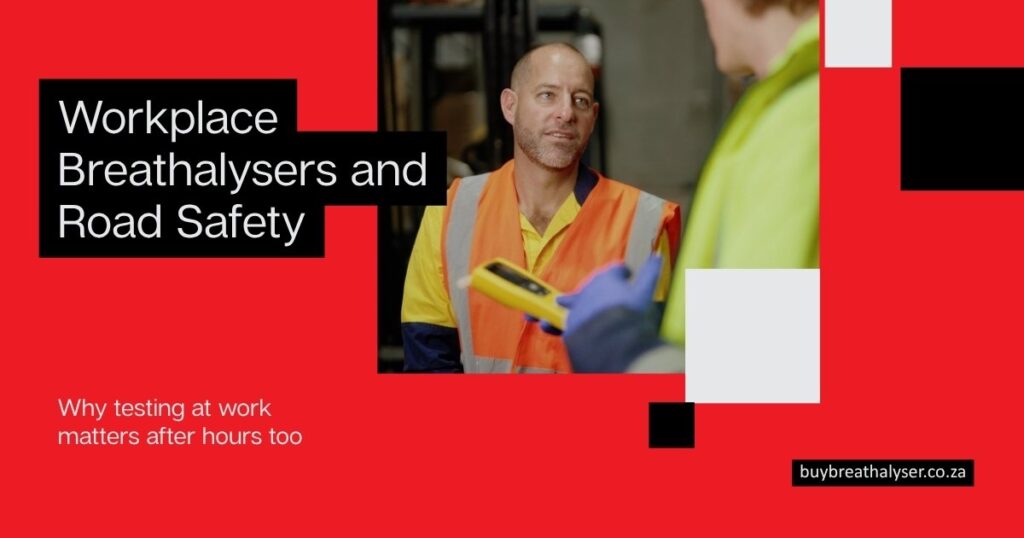
Most companies think of breath alcohol testing as a gate check: is this person fit to work today? Fair enough. But a well-run testing programme has a quieter benefit that matters a lot in South Africa. It shapes how people think about alcohol and driving, long after the shift ends.

The problem on our roads
Alcohol plays a big part in South Africa’s road deaths. According to Arrive Alive and the AA (as cited by RunRite), nearly a third of fatal crashes on our roads involve alcohol. The Road Traffic Management Corporation has put the economic cost of road fatalities at about R200 billion a year.
Those figures cover hospital bills, legal costs and lost productivity. Many of those costs land on employers too, through absent staff, damaged fleet vehicles and the loss of experienced people.
The legal limits
Under current South African law, drivers can have no more than 0.05 g of alcohol per 100 ml of blood, or 0.24 mg per 1,000 ml of breath. Professional drivers face stricter limits. A proposed zero-tolerance limit under the National Road Traffic Amendment Bill would take the legal limit to zero.
If you run a fleet, a logistics operation or any site where people drive for work, those numbers should be part of your alcohol policy.
How workplace testing changes behaviour
Testing isn’t about catching people out. It’s about making alcohol limits real and personal. Here’s how a workplace breathalyser programme helps.
Accountability
When employees know they may be tested at the start of a shift, they think twice about that late night or the “one for the road”. The same thinking carries over to weekends and the drive home.
Self-awareness
A good breathalyser gives an immediate reading. Over time, staff who self-test learn how alcohol affects them and how long it takes to clear. For self-testing programmes, RunRite recommends the Alcolizer Centurion Quantum, a wall-mounted unit built for unsupervised, high-volume testing. With BrAC results staff can manage and self-regulate their habits to not contravene workplace regulations.
Safer roads
Every employee who decides not to drive after drinking lowers the risk for themselves, their colleagues and everyone else on the road. Your policy becomes part of a much bigger solution.

Choosing the right equipment
Results you can’t trust undermine the whole programme, so equipment matters. The Alcolizer range sold by RunRite Electronics is built to Australian Standards for breath alcohol testing (AS3547), and several current models meet the updated AS3547:2019 standard.
Some options to think about:
- Handheld testing for supervisors and security: the Alcolizer HH4 is a portable industrial breathalyser certified to AS3547:2019.
- Access control and self-testing at the gate: the Alcolizer Centurion Zero Tolerance suits sites with many people coming through at shift change. This includes drivers of vehicles at the boom gate with automated testing options (see image above)
- Hygiene and consumables: stock up on Alcolizer standard mouthpieces so each person gets a fresh one.
Making it work: policy first
A breathalyser is only as good as the policy around it. Before you roll out testing, make sure you have:
- A written alcohol and drug policy that sets out who is tested, when and what happens after a positive result.
- Clear communication so employees know the reasons for testing and how it works.
- A fair process for positive results, including confirmation testing.
- A calibration and maintenance schedule so readings stay accurate.
Frame it as a safety and wellbeing measure, not a punishment, and you’ll get far more buy-in.
The bottom line
Workplace breath testing protects your site, and it can also help keep your people alive on the road. That’s a good return on a fairly small investment.