
Professional vs Cheap Breathalysers: Why Sensor Technology Matters at Work
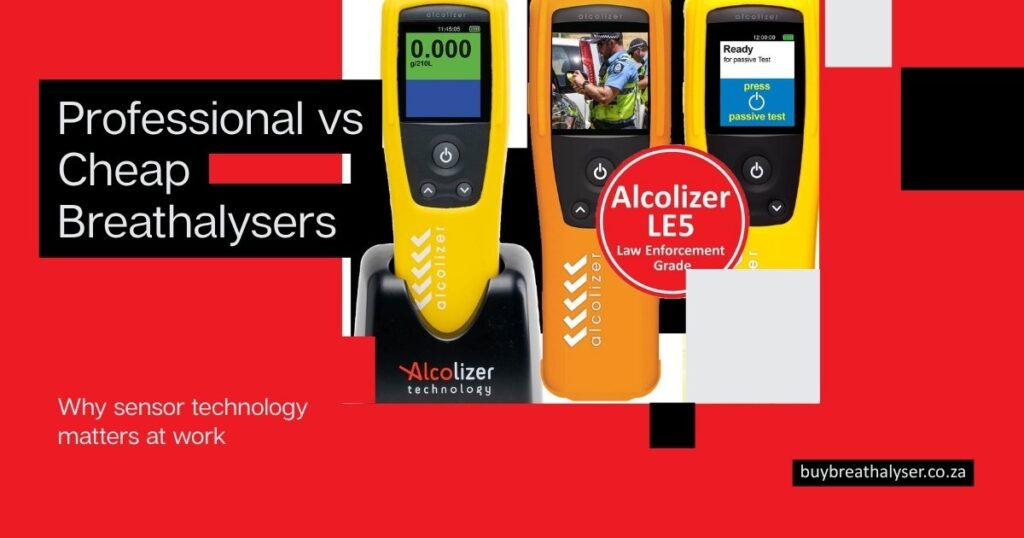
A quick online search turns up breathalysers for a fraction of what a professional unit costs. For a business it’s tempting: why spend more when a cheaper device seems to do the same job? The answer comes down to the sensor inside, and it can decide whether your testing programme holds up at all.
Two very different technologies
Semiconductor sensors
Most cheap breathalysers sold in pharmacies, big retailers and online use semiconductor sensors. The sensor is a small bead of tin oxide that has to be heated to about 300 °C. When alcohol and other substances touch it, its electrical resistance changes, and the device turns that change into a reading.

Fuel-cell sensors
Professional instruments, including the ones used by law enforcement, use fuel-cell technology. It has been developed and refined over many years and is more precise, accurate and reliable. The Alcolizer range sold by RunRite Electronics falls into this professional category. Fuel cells are profiled to ensure that even in the presence of low levels of alcohol they remain reliable.
Why semiconductor testers fall short at work
They react to things other than alcohol
Tin oxide sensors aren’t very selective. Petrol vapour, cigarette smoke, hairspray, breath acetone and many other airborne substances can set them off. That means false positives: the device shows alcohol when there isn’t any.
Picture that at a fuel depot, a workshop or a smoking-area gate. One false positive means a sober employee sent home, a dispute and a hit to the programme’s credibility.
They don’t last
The more you use a semiconductor sensor, the faster it degrades and the less accurate it gets. The source notes they rarely last more than a year, because smoke and other contaminants easily foul the sensor, and heavy alcohol exposure can destabilise it. High-volume workplace use is the worst case.
Their readings are unpredictable
Semiconductor devices can detect that alcohol is present, but they can’t measure it reliably. A reading may be high, low or correct, and there’s no way to know which. Near the legal limit, that error margin makes the result close to useless.
They lack approvals
A semiconductor device will make accuracy claims but will not carry and Standard Mark such as AS3547 or even DOT approvals from the US. Generally these are actually throw away style devices and will not even have a calibration procedure in place.

What to look for in a workplace breathalyser
- Fuel-cell sensor technology: check the spec sheet. If the technology isn’t named, ask.
- Certification to a recognised standard: for example AS3547. The Alcolizer HH4 and Alcolizer LE5 meet AS3547:2019.
- Built for the volume you’ll test: a handheld for supervisors, or a fixed station such as the Alcolizer Centurion Quantum for gates and self-testing.
- Calibration support in South Africa: a device you can’t get calibrated locally won’t stay accurate.
- Hygienic consumables: options like the anti-blowback mouthpiece keep each test clean.
The real cost of “cheap”
Think about what the cheap device costs you in total: replacements every year, false positives that mean lost shifts and disputes, and results that may not stand up in a disciplinary hearing. A professional fuel-cell tester costs more upfront, but it gives you results you can act on.